
 06 Jan 2026
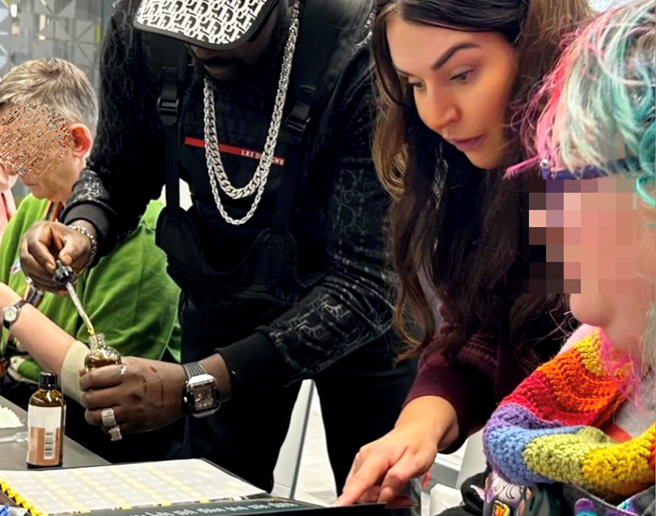
Image shows: Stacey leading a Community of Practice for professionals with lived experience, focussed on wellbeing using mindful stitching and aromatherapy
"What does it take to create spaces that are safe enough for those with lived experience to lead research into the very issues that caused them harm?" Mental Health Research for All fellow Stacey Smith explores a topic that has been central to her research.
My Mental Health Research for All fellowship with NIHR ARC North Thames sits at the intersection of lived experience, ethics, and innovation. I’ve been asking what it means to create research that truly serves those most affected, while building spaces where people who have been harmed can step into academia and lead.
This work has given me the privilege of collaborating with colleagues committed to trauma-informed approaches, while engaging directly with women whose lives have been marked by domestic abuse and systemic failures.
Throughout my experiences, and more recently, I have been reflecting on how survivor-led research challenges traditional notions of ethics and reshapes what it means to create knowledge responsibly. I finally felt like I understood the importance of how we develop methodologies that centre lived experience in research.
Yet stepping into this role has revealed unexpected ethical complexities, questions about what emotional safety really means, highlighting the nuances of power, and responsibility that goes far beyond methodology.
I’ve been wondering: what does it take to create spaces that are safe enough for those with lived experience to lead research into the very issues that caused them harm? How do we create environments that support and empower all researchers to lead with integrity, authority and safety?
The Ethics of Emotional Risk: Rethinking Safety in Lived Experience-Led Research
Survivor involvement, or participatory designs, are often framed as empowering for people with lived experience.
Yet this narrative can sometimes oversimplify a reality that is far more complex. I think we need to see empowerment differently. It is not a static state; it exists alongside vulnerability, and in the context of trauma-related research, that vulnerability can be deep and complex.
Engaging with narratives of harm or injustice, is not a neutral act. For those of us whose histories echo the stories we study, immersion can reopen wounds, blur boundaries, and evoke emotional responses that conventional research ethics rarely anticipate.
Leading as someone with lived experience is, of course, meaningful. But it demands emotional labour that is invisible in most methodological frameworks, and it exposes us to risks that are seldom acknowledged in institutional discourse.
"Leading as someone with lived experience is, of course, meaningful. But it demands emotional labour that is invisible in most methodological frameworks..."
For example, revisiting narratives of abuse has, at times, triggered embodied memories for me, moments where the line between professional engagement and personal vulnerability blurred.
Participating in meetings where systemic failures were debated evoked feelings that could momentarily pull me back into a place of pain and helplessness.
Even seemingly routine tasks can become emotionally charged when they intersect with unresolved trauma.
And we must name this truth: trauma is never fully resolved. It lives in the body, in memory, in the spaces between words.
Too often, risk is either avoided – meaning individuals with significant lived experience are excluded from research roles altogether – or it is minimised to an “acceptable” standard to allow access, without truly addressing the complexity of what that risk entails.
Both approaches are problematic.
Avoidance perpetuates exclusion and silences voices that could transform research. Minimisation creates a false sense of safety, framing risk as something that can be neatly contained, rather than something to be acknowledged, planned for, and supported.
I believe we can confront this tension honestly: risk is real, and working with it, not erasing it or denying it, is the only way to ensure that participation does not come at the expense of wellbeing. Without this, the rhetoric of empowerment risks becoming another form of harm, one that hides behind good intentions.

Image shows: Stacey exploring perspectives at a Dutch art gallery
Power in the Room: When Inclusion Collides with Hierarchy
Lived experience research is being celebrated as a radical shift toward equity, but we must not forget that inclusion does not dissolve power, it simply reshapes it.
In many environments, power dynamics still remain embedded in team culture, decision-making processes and institutional norms. These dynamics can unintentionally mirror the same harms people have previously endured: silencing through subtle gaslighting, exclusion masked as “professionalism”, and hierarchies that dictate whose voice carries weight.
My experience of organisational dynamics is that power is rarely overt; it operates in the quiet spaces, whose perspective is valued or celebrated, or whose discomfort dictates what is “appropriate.”
For me, these moments are not neutral. They can evoke echoes of past institutional harm, where authority was used to diminish or dismiss my reality. When systems fail to interrogate these dynamics, they risk reproducing patterns of control under the guise of collaboration, creating conditions that retraumatise rather than empower.
These dynamics make the question of safety even more complex, because safety is not just emotional, it’s relational and structural.
What Does “Safe Enough” Mean in Practice?
Therefore, I believe safety is never absolute, it’s negotiated.
For me, “safe enough” has meant co-creating boundaries with collaborators, clarifying expectations several times, and embedding the right to step back without penalty, or feeling immense guilt or shame. This approach reflects feminist ethics of care (Gilligan, 1982), which prioritise relational accountability over rigid protocols.
But safety isn’t static. It shifts with context, capacity, and the emotional weight of the work. What feels safe today may feel overwhelming tomorrow. Recognising this means moving beyond a one-off consent form. Instead, safety becomes an ongoing conversation, a living agreement that adapts as needs change.
"Safety becomes an ongoing conversation, a living agreement that adapts as needs change."
In practice, operationalising “safe enough” requires three things:
- Boundaries that are co-produced, not imposed.
- Support that is responsive, not prescriptive.
- Processes that honour choice and flexibility.
These principles are central to enabling anyone with lived experience, trauma or neurodiversity to not only participate but to lead with confidence and competence. Because safety isn’t a checkbox, it’s a relationship.
The Value and Complexity of Lived Experience Knowledge
Lived experience in research offers undeniable advantages. Shared experience can foster trust, cultural insight, and relational depth that transform engagement with participants.
For example, the women I am walking alongside who are navigating trauma, disclosure feels safer with someone who “gets it.” This proximity can dismantle barriers that traditional researcher–participant dynamics often reinforce.
Yet, this closeness is double-edged. Lived experience research complicates boundaries, between professional and personal, between empathy and enmeshment. I have wrestled with dilemmas around confidentiality and emotional entanglement, asking whether sharing my own story served the research or satisfied my need for connection.
These tensions are not unique; they are endemic to lived experience work. As Dwyer and Buckle (2009) argue, the insider/outsider binary is porous, and researchers often occupy a “space between,” negotiating shifting identities throughout the research process.
This complexity demands rigorous reflexivity. Reflexivity is more than self-awareness; it is a systematic interrogation of positionality. It asks:
What do I know? How do I know it?
What ethical implications follow from this knowing?
Such questioning surfaces the relational power dynamics embedded in insider research. It also exposes the risk of what Pillow (2003) calls “confessional reflexivity”, where disclosure becomes performative rather than critically analytic. The challenge is to ensure that sharing personal narratives serves the research aims and participant well-being, not the researcher’s emotional needs.
To operationalise this effectively can be complex. I believe the lived experience role – in in this case, that of researcher – must be anchored in transparent positionality statements and ethical frameworks that prioritise care and accountability. These frameworks should include:
- Co-created agreements that define what is shared, when, and why.
- Spaces to process emotional labour without burdening participants.
- Recognising that consent is ongoing, not a one-time transaction.
Lived experience-led research is powerful precisely because it disrupts traditional hierarchies of knowledge. But its strength lies in coupling that intimacy with methodological rigour and ethical clarity. Without these, the trust that makes lived experience work transformative can become a site of harm, for participants and researchers alike.
Safe Enough to Lead – a Personal Reflection
“Safe enough” is not about eliminating risk, it’s about creating conditions where collaboration can thrive without harm.
In trauma-informed, lived experience-led research, safety is dynamic, negotiated, and relational. It requires boundaries that are co-produced, support structures that work in practice, and reflexivity as a core method. Ethical leadership means holding space for complexity: growth alongside harm, vulnerability alongside responsibility.
This fellowship has shown me that safety is not a checkbox but a shared responsibility. Knowledge from lived experience brings power and complexity, and co-production is most transformative when paired with rigorous ethical frameworks. These principles are not abstract, they are lived, tested, and refined through dialogue.
I am so grateful to my NIHR ARC Noth Thames Mental Health Research for All (MH-ALL) fellows, whose diverse perspectives have challenged and inspired me throughout this journey. And to my mentors- Fran, Holly and Sania- thank you for your wisdom and encouragement.
As I move forward, I carry these lessons with me, and a commitment to continue to advocate for lived experience as not just a story, but as a catalyst for change.
References
- Beresford, P. (2019). Public Participation in Health and Social Care: Exploring the Co-production of Knowledge.
- Campbell, R. (2002). Emotionally Involved: The Impact of Researching Rape.
- Clark, J. (2021). Trauma-Informed Research Practices.
- Dwyer, S. C., & Buckle, J. L. (2009). The Space Between: On Being an Insider-Outsider in Qualitative Research.
- Gilligan, C. (1982). In a Different Voice: Psychological Theory and Women’s Development.